e-Invoicing for Malaysian SMEs: What the New RM3 Million Threshold Means for You
Quick answer: Since 1 September 2026, Malaysian businesses with annual turnover or revenue below RM3 million no longer have to issue e-invoices (the threshold was RM1 million before). If your business is above RM3 million, you are in scope: businesses up to RM5 million were brought in from 1 January 2026, with a relaxation period until 31 December 2027. The exemption does not apply if your business is linked to a larger company. Always confirm your position with your accountant or LHDN.
Information checked: October 2026, based on LHDN’s e-Invoice General Guideline v4.8 (30 August 2026). We are a web studio, not tax advisers.
If you run a small business in Malaysia, e-invoicing has probably caused a few headaches this year — new software, new processes, and a lot of conflicting advice. Then, in his National Day address on 30 August 2026, the Prime Minister announced that the threshold would be raised. Here’s what changed, who it affects, and what it means if you sell online.
First, What Is e-Invoicing?
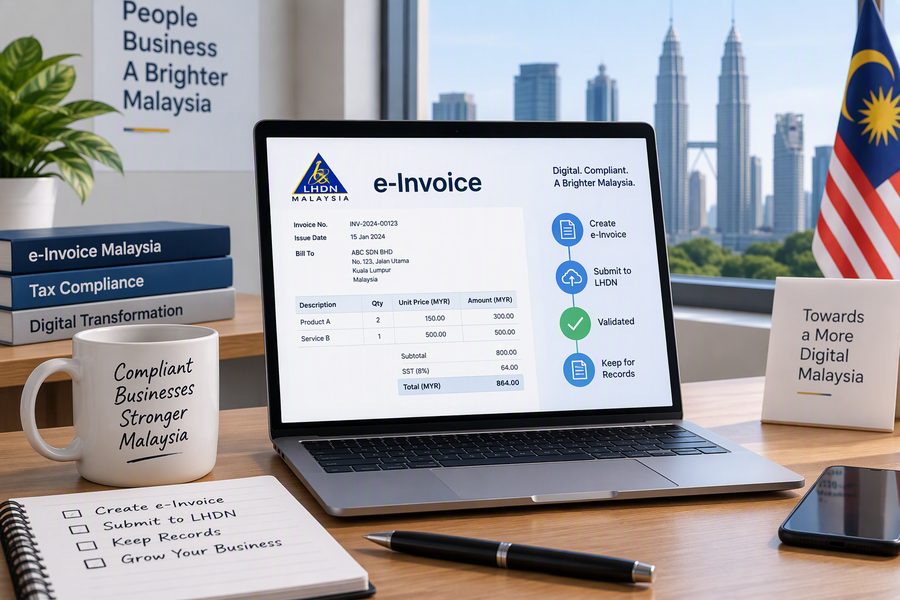
An e-invoice is a digital invoice that is sent to LHDN (the Inland Revenue Board) through its MyInvois system and validated in near real time, instead of being just a PDF or paper bill. Malaysia started rolling it out on 1 August 2024, beginning with the largest companies. According to LHDN, more than 265,000 taxpayers had submitted over 1.84 billion e-invoices by August 2026.
What Changed on 1 September 2026
The exemption threshold for micro, small and medium businesses was raised from RM1 million to RM3 million in annual sales. LHDN says this frees more than 1.1 million businesses from having to implement e-invoicing (Bernama). The exemption covers issuing e-invoices, including self-billed e-invoices, and applies to all types of taxpayers below the threshold — companies, partnerships and sole proprietors.
Where Does Your Business Stand?
| Annual turnover / revenue | What applies |
|---|---|
| Below RM3 million | Not required to issue e-invoices. You may join voluntarily. (Check the exceptions below.) |
| RM3 million – RM5 million | Required since 1 January 2026 (Phase 4). Relaxation period until 31 December 2027. |
| Above RM5 million | Already required under Phases 1–3 (August 2024 – July 2025). |
Phase dates from ClearTax’s implementation timeline; threshold from LHDN’s General Guideline v4.8, as summarised by JomeInvoice.
The Catch: When the Exemption Does Not Apply
Under the updated guideline, a business below RM3 million is not exempt if:
- a company shareholder (not an individual) has revenue of RM3 million or more;
- it is a subsidiary of a holding company with revenue of RM3 million or more; or
- it has a related company or joint venture with revenue of RM3 million or more.
So a small trading arm of a larger group may still need to comply. If your business sits inside a group structure, check this with your accountant.
If You Are Exempt
- Normal receipts and invoices still work. The guideline confirms that your normal receipts remain valid proof of expense for your buyers.
- You can still opt in. Voluntary e-invoicing is allowed — useful if your big corporate customers prefer it, or you expect to cross RM3 million soon.
- Already started between RM1 million and RM3 million? The guideline does not clearly say whether you can stop. Keep going until your accountant or LHDN confirms.
What This Means for Your Website or Online Store
For most small online sellers, the change simply removes a compliance job. But if you are above RM3 million — or growing towards it — think about how your orders reach your accounts. The usual route is accounting or POS software connected to LHDN’s MyInvois system; LHDN also provides the MyInvois Portal and MyInvois e-POS. Either way, clean, consistent order records from your online store make the job much easier.
Setting up a store now? Our guides to payment gateways in Malaysia and what an ecommerce website costs cover the rest of the picture.
Where ELF Digital Studio Comes In
We are not tax advisers, and we will always point you to your accountant for e-invoicing decisions. What we do is build websites and online stores with tidy, exportable order records — so whichever accounting system you use, your sales data is ready for it instead of being retyped by hand.
Want an online store that is easy for your accountant to work with? Talk to us — we’ll keep it simple, honestly.
Frequently Asked Questions
Do sole proprietors need to issue e-invoices?
Not if annual turnover or revenue is below RM3 million and none of the group-related exceptions apply. The exemption covers all categories of taxpayers.
My business is below RM3 million but I already use e-invoicing. Can I stop?
The updated guideline does not clearly say. Voluntary participation is allowed, so the safest approach is to continue until your accountant or LHDN confirms you can stop.
Is there a penalty if I get it wrong?
For Phase 4 businesses (up to RM5 million), LHDN has given a relaxation period until 31 December 2027. Use that time to get your process right, with your accountant’s help.
Where can I get official help?
LHDN’s e-Invoice helpdesk is 03-8682 8000, or email myinvois@hasil.gov.my. Guides are on the official LHDN e-Invoice page.
Sources: Bernama — e-Invoice threshold raised to RM3 million (August 2026); JomeInvoice — General Guideline v4.8 summary; ClearTax — e-Invoice implementation phases (updated September 2026); LHDN — e-Invoice.